Start with the rim joist
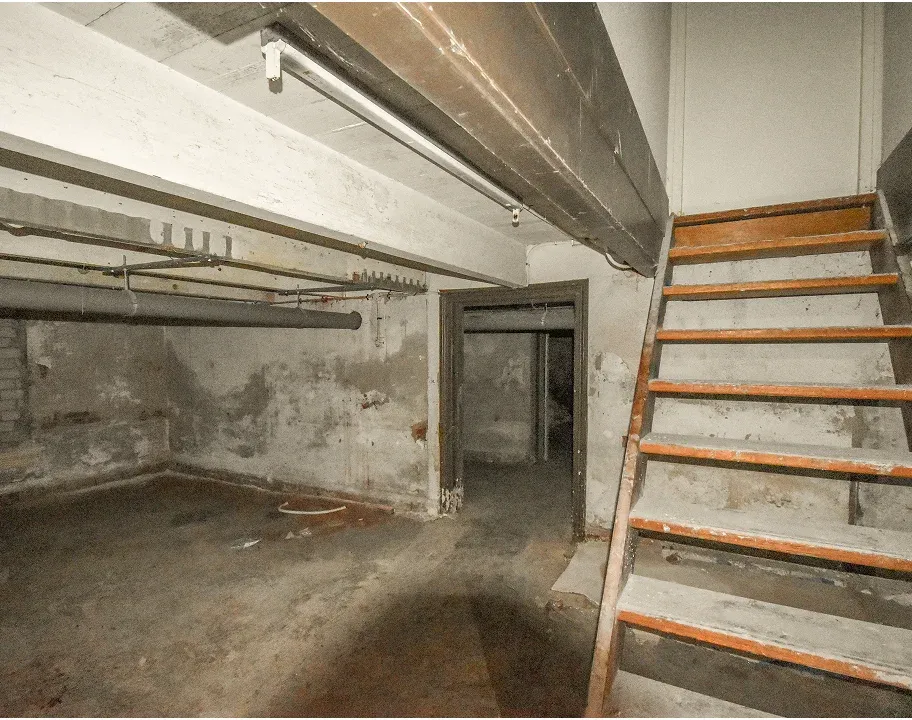
Walk into your basement and look up where the concrete wall stops and the wood begins. That band of framing running around the perimeter is the rim joist, and in most Metro Detroit homes it is doing nothing at all to keep cold out.
It is a thin piece of wood with outside air on one side and your basement on the other. It has a seam where it sits on the foundation and another where the subfloor lands on top of it. Both seams leak. In an older house, they leak a lot.
This matters more than its size suggests because of where it sits. Cold air coming in at the rim joist pours across the basement floor and up through the floor above — which is why your first floor feels cold near exterior walls even when the thermostat says otherwise. It is also the bottom half of the stack effect: air leaking out of your attic has to be replaced by air pulled in down here.
Sealing and insulating the rim joist is a small job. It is frequently the best dollar-for-dollar comfort improvement in the entire house, and we will usually recommend it alongside attic work as a pair.
- 1 The seam where the sill plate sits on the foundation.
- 2 The rim joist itself — thin wood with outside air behind it.
- 3 The seam where the subfloor lands on the rim joist.
Crawl spaces: seal it or vent it, but pick one
The building science on crawl spaces changed, and a lot of Michigan houses are stuck in the middle of the change — half-vented, half-sealed, performing badly at both.
A vented crawl space is deliberately open to outside air. The theory was that airflow carries moisture away. In a humid Michigan summer it can do the opposite: warm damp air enters, hits cool surfaces, and condenses. If yours is vented and staying that way, the insulation belongs in the floor above, with the crawl space treated as outdoors.
A sealed crawl space is closed off, ground covered with a vapor barrier, walls insulated, and the space brought inside the thermal boundary. This generally performs better and smells better, but only if the moisture is genuinely handled first.
What does not work is insulating the floor above, leaving the vents open, and hoping. Or sealing the vents without addressing ground moisture, which turns the crawl space into a humidor.
We look at which one you actually have before recommending anything.
Moisture comes first. Always.
This is the part where we sometimes talk ourselves out of a job.
Insulation covers things. If there is water coming into your basement or crawl space, covering it means you stop seeing it while it keeps happening — now behind material that holds moisture against your framing. That is worse than doing nothing.
Before we insulate below grade we look for the ordinary causes, in this order:
- Downspouts dumping at the foundation instead of six feet away. Free to fix, fixes a surprising number of “wet basement” calls.
- Grading that slopes toward the house. Not our trade, but we will tell you when we see it.
- Bulk water through a crack or a failed sump. Needs a waterproofing contractor before we touch it.
- Ground moisture in a dirt-floor crawl space. Needs a proper vapor barrier, which is our work.
- Dryer and bath fans venting into the space instead of outside. Common, cheap, and a genuine moisture load.
If one of the first three is in play, we will tell you to handle it and come back. We would rather do the job later and have it work.
What you feel afterward
Warmer floors on the first level, most noticeably in the rooms over the crawl space or along the basement perimeter. Less of that draft along the baseboards. In a finished basement, the cave smell goes away — that smell is damp, and damp is what we are cutting off.